Dental and Medical Clinic Cleaning in Abbotsford, Langley and Surrey
Cleaning that meets your infection-control obligations without filling a treatment room with solvent vapour. We clean where cleaning is what the surface needs, and we disinfect with a registered product where your protocol says to.
Clinic cleaning is a scheduled after-hours visit covering operatories, waiting room, washrooms and every high-touch surface between them. Soil removal is done with plant-derived detergent, microfibre and HEPA vacuuming. Where a surface is clinically warranted, we disinfect with a product carrying an eight-digit Health Canada DIN, and that DIN goes in your written scope.
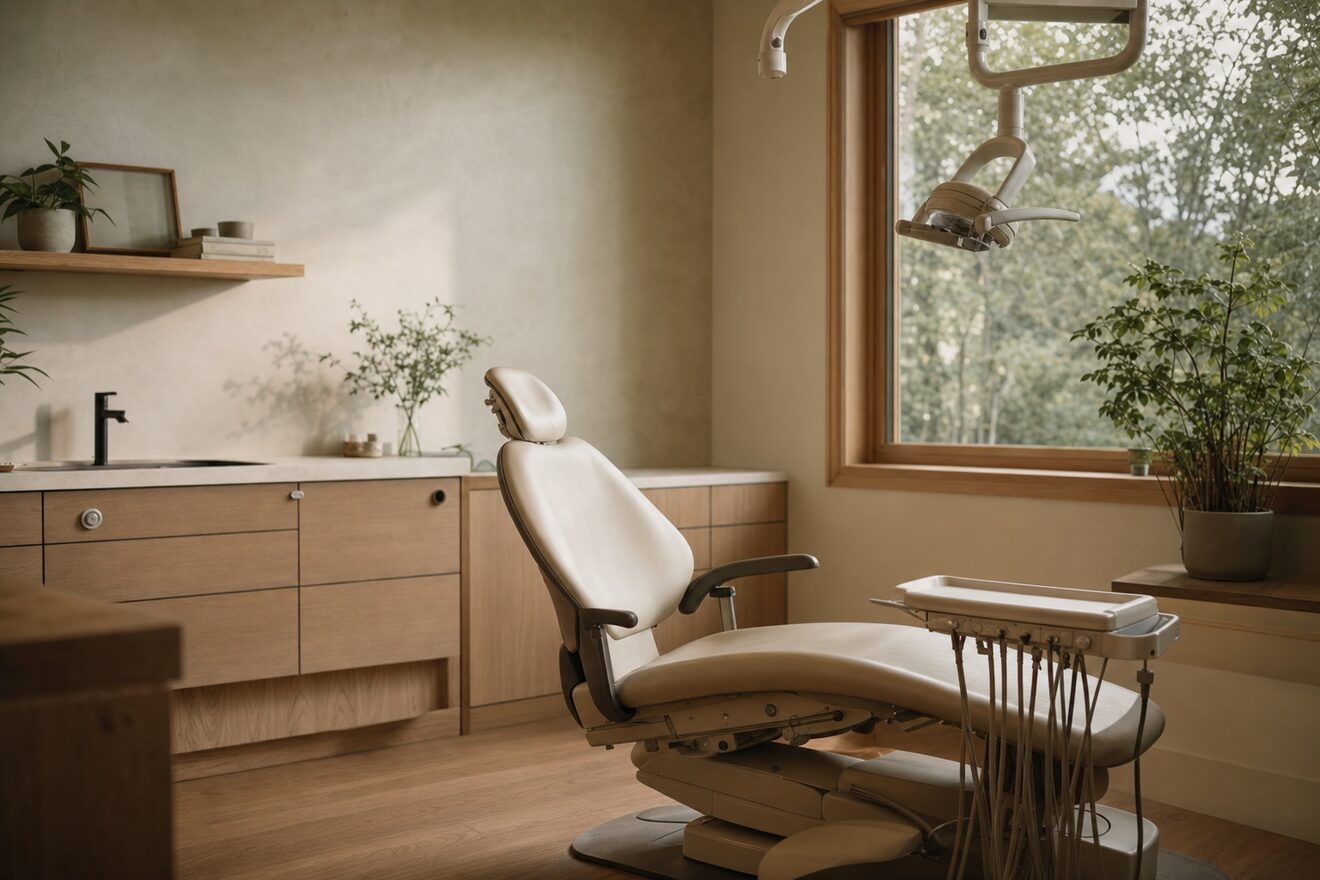
What does a clinic clean actually include?
Room by room, because a treatment room and a waiting room are different problems. This is the standard scope. Yours is written down after the walkthrough and it is the document we get measured against.
-
Reception and waiting room
Every visit: reception counter on both faces, the payment terminal, the pen, the clipboard and the sign-in screen. Waiting room chair arms, seat backs and the underside of the arm rests, which is where hands actually go. Door handles and push plates on both faces, including the exterior entry handle. Light switches. The glass at hand height, where the marks are. Magazine and brochure surfaces wiped or removed. Water cooler taps and drip tray. Toys or a children's corner wiped, or set aside for your own sanitising if that is your policy. Floors HEPA vacuumed, hard floors damp-mopped with edges done by hand. Bins emptied, liners replaced.
-
Operatories and treatment rooms
Every visit, after the last patient: hard horizontal surfaces, counters, the cabinetry fronts and handles, the chair base and pedestal, the arm rests, the delivery unit exterior, the light handle and arm, the monitor bezel and the stool. The hand sink, tap, splash zone and the body of the soap and sanitiser dispensers. Chair-side waste bin emptied and the lid mechanism wiped. Wall spatter zone behind the chair. Floors damp-mopped with a fresh microfibre pad per room, corners by hand. Surfaces identified in your protocol as requiring disinfection are disinfected with a DIN-carrying product at its labelled contact time, not wiped and dried in three seconds.
-
Sterilization and instrument reprocessing area
The boundary is written into the scope. We clean the floor, the exterior of the cabinetry, the door, the switch plates and the general waste bin. We do not touch instruments, trays, pouches, the ultrasonic bath, the autoclave chamber, or anything sitting on the clean side of the bench. Reprocessing is your staff, your protocol and your record, and a cleaner in it at night is a liability rather than a service.
-
Washrooms
Every visit: toilet inside and out including the hinges, the base and the wall behind it. Grab bars and the accessible rail. Sink, tap, basin underside and the splash wall. Mirror. Dispenser bodies for soap, paper and sanitiser, refilled from your stock. Baby change table where fitted, disinfected rather than wiped. Bin and sanitary unit emptied. Floor washed by hand along the skirting and behind the pedestal, which is the part a mop never reaches. Vent cover dusted monthly.
-
Staff room, admin and corridors
Every visit: kitchen counters, sink, tap, microwave inside and out, fridge door and handle, kettle base, table and chair rungs, bin and the bin lid handle. Admin desks wiped around whatever is left out, because we do not move charts or paperwork and never open a drawer. Keyboards, phone handsets and monitor bezels. Corridor floors, skirting at eye level for scuffs, and the full high-touch list: light switches, door handles, push plates, stair rails, elevator buttons and the photocopier lid and panel.
-
Periodic work, and the reporting
Monthly: vents and diffusers dusted, high dusting on ledges and frames, chair and cabinet bases done low, interior glass in full, fridge interior on request. Quarterly: light fittings, blinds, skirting boards throughout, and behind movable equipment. Every visit produces a timestamped photo report, a named cleaner rather than a rotating stranger, and a same-night note on anything broken, leaking or left unlocked, because we are often the last people in the building.
How often does each zone get done?
A starting grid, not a fixed rule. Chair count, patient volume and how many days a week you are open all move it, and the walkthrough is where it gets set.
| Zone | Typical frequency | What that means in practice |
|---|---|---|
| Operatories and treatment rooms | Every visit, after the last patient | Fresh microfibre pad per room. Disinfectant only on the surfaces your protocol names, at its labelled contact time. |
| Washrooms | Every visit | Full clean plus a registered disinfectant on the toilet, the change table and the tap handles. |
| Reception and waiting room | Every visit | Every hand-contact surface, plus the floor. Fragrance-free by default so the room smells of nothing. |
| Staff room and admin | Every visit | Cleaned around paperwork. No drawers opened, no charts moved. |
| Vents, high dusting, interior glass | Monthly | Dust that has settled above eye height, which is where the waiting-room air actually comes from. |
| Light fittings, blinds, behind equipment | Quarterly | Scheduled in advance so it lands on a day the practice is closed or quiet. |
| Sterilization area, instruments, sharps | Never, by design | Floor and cabinet exteriors only. Everything else stays inside your protocol and your record. |
Clean, sanitize and disinfect are three different jobs.
Almost all natural-cleaning marketing collapses these three words into one, and in a clinic that is not a stylistic problem, it is a clinical one. Your patients are already anxious and some of them are asthmatic. A waiting room that smells of chemical pine is doing you no favours, and the surfaces that genuinely need a registered disinfectant get one carrying a Health Canada DIN.
Cleaning physically removes soil, grease and dust, and with them most microorganisms, using a surfactant plus mechanical action plus rinsing. It does not kill. It removes and dilutes. Sanitizing reduces microorganisms to a level public health considers safe: in Canada a food-contact sanitizer with no disinfectant claim must demonstrate a 99.9 per cent, or 3-log, reduction within five minutes. Disinfecting kills or inactivates specified pathogens on hard, non-porous surfaces, and a product claiming both disinfectant and sanitizer use must show a 99.999 per cent, or 5-log, reduction of specified bacteria in 30 seconds at 20°C (Health Canada, Hard Surface Disinfectants Monograph; NCCEH, food-contact sanitizers).
The part that decides who you can hire: in Canada the category is set by the claim and the use, not by the chemistry. A product marketed as a disinfectant must hold Health Canada market authorisation and carry an eight-digit Drug Identification Number on the label. No DIN, no legal disinfectant claim. So when we disinfect an operatory surface, we do it with a DIN-carrying product and we put the DIN in your scope. Health Canada publishes the searchable list of authorised surface disinfectants so you can check ours against it.
And the honest half of the same sentence: a homemade preparation is a cleaner, not a disinfectant. Vinegar holds no DIN. Rutala's home disinfectant testing found vinegar eliminated under 3 log10 of S. aureus and E. coli, and in some analyses about 1 log10 at 30 seconds, against 5.6 to 8.2 log10 for registered products (Rutala et al., 2000). The National Collaborating Centre for Environmental Health, hosted at the BC Centre for Disease Control, concluded that the appropriateness of alternatives such as vinegar, lemon juice and baking soda appears to be limited for commercial disinfection or sanitization. No clinic should be run on vinegar and we will never suggest one is.
What that leaves is a large amount of cleaning where a disinfectant adds nothing measurable. Rutala, Gergen and Weber's hospital work compared mopping systems across 24 rooms per condition: a microfibre system with a plain detergent removed 95 per cent of microbes against 68 per cent for a cotton string mop, and adding a disinfectant to the microfibre system produced no improvement at all, 95 per cent either way (American Journal of Infection Control, 2007). The honest caveat travels with it: a 2019 Journal of Hospital Infection study found microfibre with water alone less effective than detergent or sporicidal products and concluded it should not replace biocidal products in clinical settings. Which is exactly our position: microfibre and detergent for the floor, a registered disinfectant where the protocol says so.
The non-toxic products we use, named one by one, and if you want the long version of this argument, vinegar versus bleach: which one actually disinfects and how to disinfect without bleach.
What should a clinic expect to pay?
A fixed monthly figure against a written scope, quoted after a walkthrough. GST on top.
There is no clinic rate card, and any company that gives you one over the phone has not seen your floors.
What a walkthrough actually prices on, in roughly the order it moves the number: how many operatories or treatment rooms and how many of them are in use daily, how many washrooms and fixtures, total floor area and how much of it is hard floor against carpet, how many nights a week we come, whether there is a staff kitchen with real dishes, how much of your protocol requires a registered disinfectant rather than a clean, your access and alarm arrangements, and whether we can start before your front door is locked. A two-chair practice with one washroom and a six-operatory clinic with four are different businesses.
We do not publish a per-square-foot number, and the reason is more useful than a shrug. Published Canadian guides put standard janitorial at $40 to $60 an hour, or $0.10 to $0.25 per square foot, while another puts a standard commercial clean at $0.30 to $0.60 per square foot. Those two ranges disagree by roughly threefold, almost certainly because one is quoting per visit and the other per month, and because they are quietly describing different task lists. Picking a midpoint between two numbers that measure different things would be inventing a price. So we quote your building instead, and then hold the figure.
For a general office rather than a clinical space, the office cleaning page is the simpler starting point, and the mechanics of a scheduled contract sit on janitorial contracts.
What you get in writing, before you sign anything.
Every line here is checkable. That is the whole point of it.
-
Fixed monthly rate
Quoted after a walkthrough, not per hour, so your budget line does not move.
-
Photo report after every visit
Timestamped, so you can see the work was done without being on site.
-
A named substitute
Someone trained on your building covers holidays and sick days. The schedule does not lapse.
-
Proposal within 24 hours
After the walkthrough, in writing, with the product list attached.
-
Insurance certificate on request
Named to your building or your management company where you need it.
-
30 days notice, either way
No multi-year lock-in. If we are not doing the job, you should be able to leave.
Other buildings we clean: daycares & preschools, strata & property management, salons, spas & studios, offices & workplaces. Or start at commercial cleaning across the Fraser Valley.
Clinics across the Valley.
Single practices, and multi-site groups where the buildings sit close enough that one crew can hold the same standard across all of them.
- Cleaning in Abbotsford
- Cleaning in Langley
- Cleaning in Surrey
- Cleaning in Chilliwack
- Cleaning in Mission
- Cleaning in Maple Ridge
Dental and medical clinics in Abbotsford and Langley, physio and chiro in Surrey and Cloverdale, optometry and family practice in Chilliwack, Mission and Maple Ridge, plus Aldergrove, South Surrey, White Rock, Delta and Pitt Meadows. All service areas.
What practice managers ask first.
Do you actually disinfect, or only clean?
Both, on the surfaces where each one belongs. Cleaning physically removes soil and, with it, most microorganisms. Disinfecting kills or inactivates specified pathogens on hard non-porous surfaces. In Canada a product claiming both disinfectant and sanitizer use must show a 99.999 per cent (5-log) reduction of specified bacteria in 30 seconds at 20°C, and it must carry an eight-digit Health Canada DIN to make the claim at all. On your clinical contact surfaces we use a DIN-carrying product. On floors, corridors and the waiting room we clean, because that is what those surfaces need.
Which product goes on which surface, and can our protocol reference it?
Yes, and this is the reason to hire us rather than a company that will not tell you. The written scope names the product used in each zone, and for the disinfectant it lists the DIN and the contact time on the label. Your own infection-control protocol can cite that document directly. If you change to a product your regulatory college or your manufacturer specifies for a particular surface, we will use yours instead and record the change.
Do you go into the sterilization area or handle instruments?
No. Instrument reprocessing is your staff, your protocol and your record. We clean the floor, the exterior of the cabinetry, the door and the light switches in that room, and we do not touch the ultrasonic bath, the autoclave chamber, the pouches, the trays or anything on the clean side of the bench. The boundary is written into the scope so nobody has to guess at eleven at night.
What happens with sharps, biohazard and clinical waste?
They stay in your stream. We do not empty sharps containers, we do not handle biohazard bags, and we do not clean up blood or bodily fluid beyond an ordinary washroom incident. That work needs training and a disposal chain we do not hold, and we will say so the first time you ask rather than the first time it happens. General waste, recycling and paper we handle normally.
When do you clean a clinic?
After the last patient, or before the first. Nobody should be sitting in a room while it is being cleaned, which matters more in a treatment room than almost anywhere: an anxious patient in a chair does not need to breathe a freshly applied product, and neither does your hygienist. For operatory turnover between patients, that is your staff on your protocol. We are the end-of-day clean underneath it.
Why does a waiting room smell matter clinically?
Because a meaningful share of the people in it react to fragranced products. Population surveys by Steinemann found roughly a third of adults report adverse effects from fragranced consumer products, and about 15.7 per cent report health problems from being in a room cleaned with scented products, rising to a majority among people with asthma. These are self-reported symptoms rather than clinical diagnoses, so we do not overstate them. We simply default to fragrance-free and remove the question.
Book a walkthrough.
Twenty minutes on site, after hours if that suits you better. A written scope naming the product used in every zone, and a fixed monthly price, within 24 hours.
Request a clinic walkthrough
We reply the same working day. Or call (819) 743-5953.