Daycare and Preschool Cleaning in Abbotsford, Langley and Surrey
Children spend the day at surface height, with their hands on everything and a good share of it in their mouths. What gets left on a table after closing is the whole question, and almost nobody in this region will tell you what they leave.
Daycare cleaning is an after-hours visit covering activity rooms, nap areas, washrooms, diapering stations and food surfaces, with fragrance-free plant-based products and no residue left where children put their hands and mouths. Diapering and washroom surfaces get a disinfectant carrying a Health Canada DIN. Photo report after every visit.
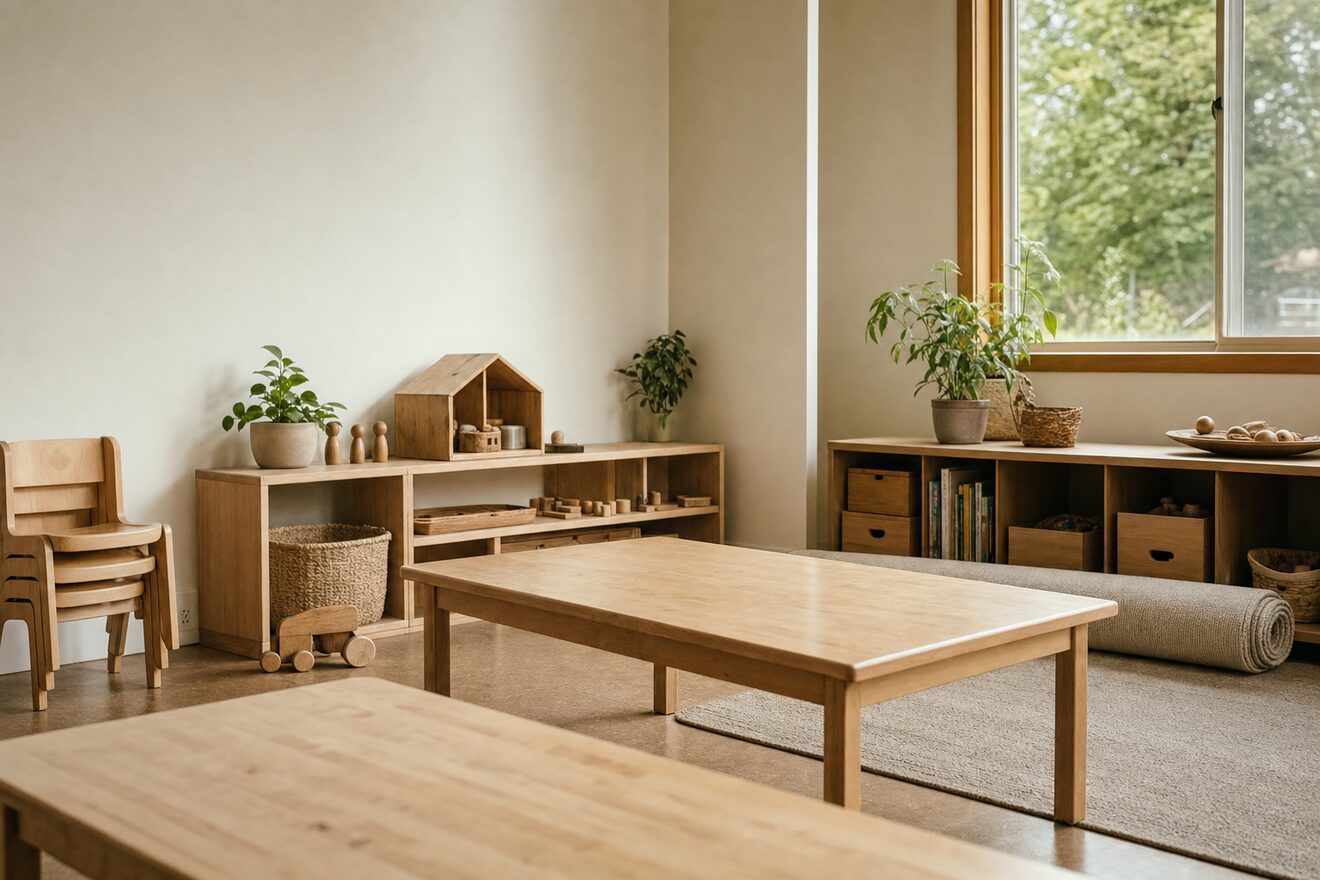
What does a daycare clean actually include?
Zone by zone. Note how much of this list sits below adult waist height, which is the part a standard commercial scope quietly misses.
-
Activity rooms and low surfaces
Every visit: tables and chair backs, and the underside of every table edge, which is where hands actually grip. Chair legs and rungs. Shelving fronts, bin and basket exteriors, and the shelf the toys live on. The low third of every wall and door, plus door edges and frames at child height. Light switches at both child and adult height. Window ledges and the glass at hand height. Carpet and mats HEPA vacuumed, hard floors damp-mopped with a fresh microfibre pad per room. Bins emptied, liners replaced, and the bin lid handle wiped.
-
Diapering, toileting and washrooms
Every visit, and this is the zone where we disinfect rather than clean. Change table surface and the edges, the step, the rail, the bin and its foot pedal. Child toilets and potty chairs inside and out, including the hinges, the base and the wall behind. Grab rails and step stools. Sinks, taps, the splash wall and the underside of the basin. Soap and paper dispenser bodies, refilled from your stock. Mirrors at child height. Floors washed by hand along the skirting and behind the pedestal. Disinfection here uses a product carrying an eight-digit Health Canada DIN, at its labelled contact time.
-
Snack, kitchen and food surfaces
Every visit: eating tables and their undersides, counters, sink, tap and drain, the fridge door and handle, microwave inside and out, the kettle base and the cupboard fronts. Bins and the bin lid handle. High chairs and booster seats including the straps anchorage and the tray underside. Floor washed by hand at the edges. Food-contact surfaces are treated as food-contact surfaces: in Canada a food-contact sanitizer with no disinfectant claim must demonstrate a 99.9 per cent, 3-log, reduction within five minutes, and that is a different standard from a general disinfectant, so the scope names which product goes where.
-
Nap area and quiet room
Every visit: cot and mat surfaces wiped and left dry, cot frames and feet, the stack rack, and the floor beneath the whole arrangement rather than around it. Blackout blind pulls. Low shelving. Bedding and soft items go through your laundry on your own schedule, because that is a record you keep and we do not. If a room is carpeted, HEPA vacuuming matters more here than anywhere else in the building.
-
Entry, cubbies and the mud room
Every visit: cubby interiors and the divider edges, coat hooks, boot trays lifted and the floor beneath them washed, the bench and the underside of the bench. Sign-in surface, pen and the door buzzer plate. Entry mats lifted, the floor under them cleaned, and the mats themselves vacuumed on both faces. Exterior door handles and push plates. In this climate this is the dirtiest square metre in the building and it is usually done last and fastest. We do it first.
-
Periodic work, staff areas, and the reporting
Weekly: staff room and office, interior glass in full, skirting boards throughout. Monthly: vents and diffusers dusted, high dusting on ledges and frames, cot and shelf undersides, fridge interior on request. Quarterly: light fittings, blinds, and behind movable furniture. Every visit produces a timestamped photo report and a named cleaner, and anything broken, leaking or left unlocked is reported the same night.
How often does each zone get done?
A starting grid. Group size, age range and how many days a week you run all move it, and the walkthrough is where it gets set.
| Zone | Typical frequency | Clean or disinfect |
|---|---|---|
| Diapering, toilets, potty chairs, taps | Every visit | Disinfect, with a DIN-carrying product at its labelled contact time |
| Eating tables, high chairs, food counters | Every visit | Clean, then sanitize to the food-contact standard |
| Activity tables, chairs, low walls, cubbies | Every visit | Clean. Detergent, microfibre and rinsing, no residue left behind |
| Floors, mats, entry and mud room | Every visit | Clean. HEPA vacuum, then damp mop with a fresh pad per room |
| Interior glass, skirting, staff areas | Weekly | Clean |
| Vents, high dusting, cot undersides | Monthly | Clean |
| Toys, soft furnishings, bedding | Yours, on your own record | Your licensing routine, your staff, your log |
The residue is the point, not the smell.
Household cleaning substances are the single largest category of poison-centre exposures for children under six. Parents on a waiting list ask what you clean with, and being able to hand them a list is worth more than any brochure.
The number behind that sentence is worth stating precisely. In the 2024 Annual Report of the National Poison Data System, the top substance category for children aged five and under was household cleaning substances, at 9.96 per cent of exposures, ahead of cosmetics and personal care at 9.15 per cent, analgesics at 8.85 per cent and foreign bodies and toys at 7.92 per cent. It has been the number one category every year: 10.1 per cent in the 2023 report, 10.3 per cent in 2022, 11.3 per cent in 2020 (Clinical Toxicology, 2025).
That is American data, and we are not going to pretend it is Canadian. Canada publishes no equivalent consolidated national poison-data annual report, so the best available annual dataset on this question is the US one. British Columbia has its own centre, the BC Drug and Poison Information Centre, but it does not publish a comparable annual ranking. Read the figure as what it is: a stable, well-collected measure of which product category most often ends up in a small child, in a country whose household cleaning shelf looks a great deal like ours.
A daycare is not a house, and the exposure route is different. Nobody is leaving a bottle out. The exposure route in a childcare centre is residue: whatever stayed on the table, the chair rung, the cubby edge and the low wall after the building was cleaned at nine the previous night, on surfaces that a two-year-old will have their hands and their mouth on by nine the next morning. Which is why our scope specifies rinsing on child-contact surfaces rather than spray-and-leave, and why the default across the whole building is fragrance-free. Health Canada is direct about the second point: minimise scented products, because they can hide odours by producing VOCs, and VOCs can cause breathing problems, headaches, and irritation to the eyes, nose and throat (Health Canada, Healthy Home Guide).
On disinfectant wipes: most of them are built on quaternary ammonium compounds, the quats. Quats demonstrably cause occupational asthma in some exposed individuals, confirmed by specific challenge testing in nurses handling benzalkonium chloride products (Purohit et al.). The size of the population-level risk is genuinely contested, and a 2019 methodological review argued much of the human research has design weaknesses (Allergy, Asthma and Clinical Immunology, 2019). Both halves are true. Together they are enough reason to avoid routine whole-building quat use where cleaning would do the job, without claiming quats cause asthma in general.
Our plant-based product list, named and linked to its safety data sheets. For the version you can hand a parent, see are baby-safe cleaning products worth it and what to avoid on a Canadian label.
What should a daycare expect to pay?
A fixed monthly figure against a written scope, quoted after a walkthrough. GST on top.
Childcare runs on thin, licensed, per-space budgets, so the number matters and it has to hold still. That is why we quote monthly and fix it rather than billing by the hour.
What a walkthrough prices on: licensed capacity and the number of rooms, how many washrooms and how many are child-height, whether there is a diapering programme or the centre is toilet-trained only, total floor area and the carpet-to-hard-floor split, the number of separate entrances and mud rooms, how many nights a week we come, whether there is a full kitchen preparing food on site, and the access arrangement. An infant and toddler programme with two change tables prices differently from a three-to-five preschool of the same square footage, and that is the honest reason we do not quote from a phone call.
We do not publish a per-square-foot number. Published Canadian guides put standard janitorial at $40 to $60 an hour, or $0.10 to $0.25 per square foot, while another puts a standard commercial clean at $0.30 to $0.60 per square foot. Those disagree by roughly threefold, because they are measuring different frequencies and different task lists, and probably per visit against per month. A midpoint between two numbers that measure different things is not a price, it is a guess with a decimal point in it. Ask for the walkthrough and you get a real figure and a written scope to hold it against.
The mechanics of a scheduled contract, notice periods and who supplies the paper and liners are on janitorial contracts.
What you get in writing, before you sign anything.
All of it checkable, including the insurance certificate and the WorkSafeBC clearance letter number.
-
Fixed monthly rate
Quoted after a walkthrough, not per hour, so your budget line does not move.
-
Photo report after every visit
Timestamped, so you can see the work was done without being on site.
-
A named substitute
Someone trained on your building covers holidays and sick days. The schedule does not lapse.
-
Proposal within 24 hours
After the walkthrough, in writing, with the product list attached.
-
Insurance certificate on request
Named to your building or your management company where you need it.
-
30 days notice, either way
No multi-year lock-in. If we are not doing the job, you should be able to leave.
Other buildings we clean: medical & dental clinics, strata & property management, salons, spas & studios, offices & workplaces. Or start at commercial cleaning across the Fraser Valley.
Centres across the Valley.
Single centres, and small groups where the sites sit close enough that one crew can hold the same standard across all of them.
- Cleaning in Abbotsford
- Cleaning in Langley
- Cleaning in Surrey
- Cleaning in Chilliwack
- Cleaning in Mission
- Cleaning in Maple Ridge
Licensed daycares and preschools in Abbotsford, Langley and Surrey, before-and-after-school care in Chilliwack, Mission and Maple Ridge, plus Aldergrove, Cloverdale, South Surrey, White Rock, Delta and Pitt Meadows. All service areas.
What centre managers ask first.
Can we give the product list to parents?
Yes, and we format it so you can. You get the full list with safety data sheets, and you may put it in an enrolment package, a newsletter, a parent handbook or a notice on the door. This is the single thing no cleaning company in this region provides: ten local firms claim eco-friendly and not one of them names a product. A parent comparing two centres on a waiting list can read one of those lists and not the other.
Do you disinfect, or only clean?
Both, on the surfaces where each belongs. Diapering surfaces, toilets, potty chairs and washroom taps get a disinfectant carrying an eight-digit Health Canada DIN, used at its labelled contact time. Tables, chairs, cubbies, floors and the low third of every wall get cleaned with a plant-derived detergent and microfibre, which is what removes soil. Vinegar is not a registered disinfectant in Canada and we will not tell you otherwise.
What about toys and soft furnishings?
Toys stay yours. Your licensing routine requires a record of when toys were sanitised and by whom, and that record belongs inside your staff routine rather than with a contractor who arrives after everyone has gone home. We clean the shelves, bins and surfaces the toys live on. Fabric items, dress-up clothes and soft toys go through your laundry, not ours, for the same reason.
Does the centre smell of anything after you leave?
It should smell of nothing. Fragrance-free is the default and it is not an upgrade. Health Canada tells Canadians directly to minimise scented products because they can hide odours by producing VOCs, which can cause breathing problems, headaches and irritation of the eyes, nose and throat. A room that smells strongly of lemon in the morning is a room that had something volatile applied to it the night before.
Do you work around our licensing routine?
We work underneath it. Fraser Health licenses childcare in this region and your licensing officer will have expectations about cleaning and sanitising routines and the records you keep. We do not quote regulation at you, because those specifics sit between you and your licensing officer. What we give you is a written scope with named products, DINs, contact times and a timestamped photo report, which is the kind of document that fits inside a routine rather than fighting with it.
When do you clean, and who has a key?
After the last child leaves, or early enough in the morning that the room has been aired before the first arrives. Nobody cleans around children. Every person who holds a key to your building has had a criminal record check, and the same named cleaner comes each visit, with one named substitute already walked through the site for holidays and sick days. You are told before a substitute comes, not after.
Book a walkthrough.
Twenty minutes on site after closing. A written scope naming the product used in every zone, and a fixed monthly price, within 24 hours. The product list comes with it, formatted so you can hand it to a parent.
Request a daycare walkthrough
We reply the same working day. Or call (819) 743-5953.